
Model Overview & Print Notes
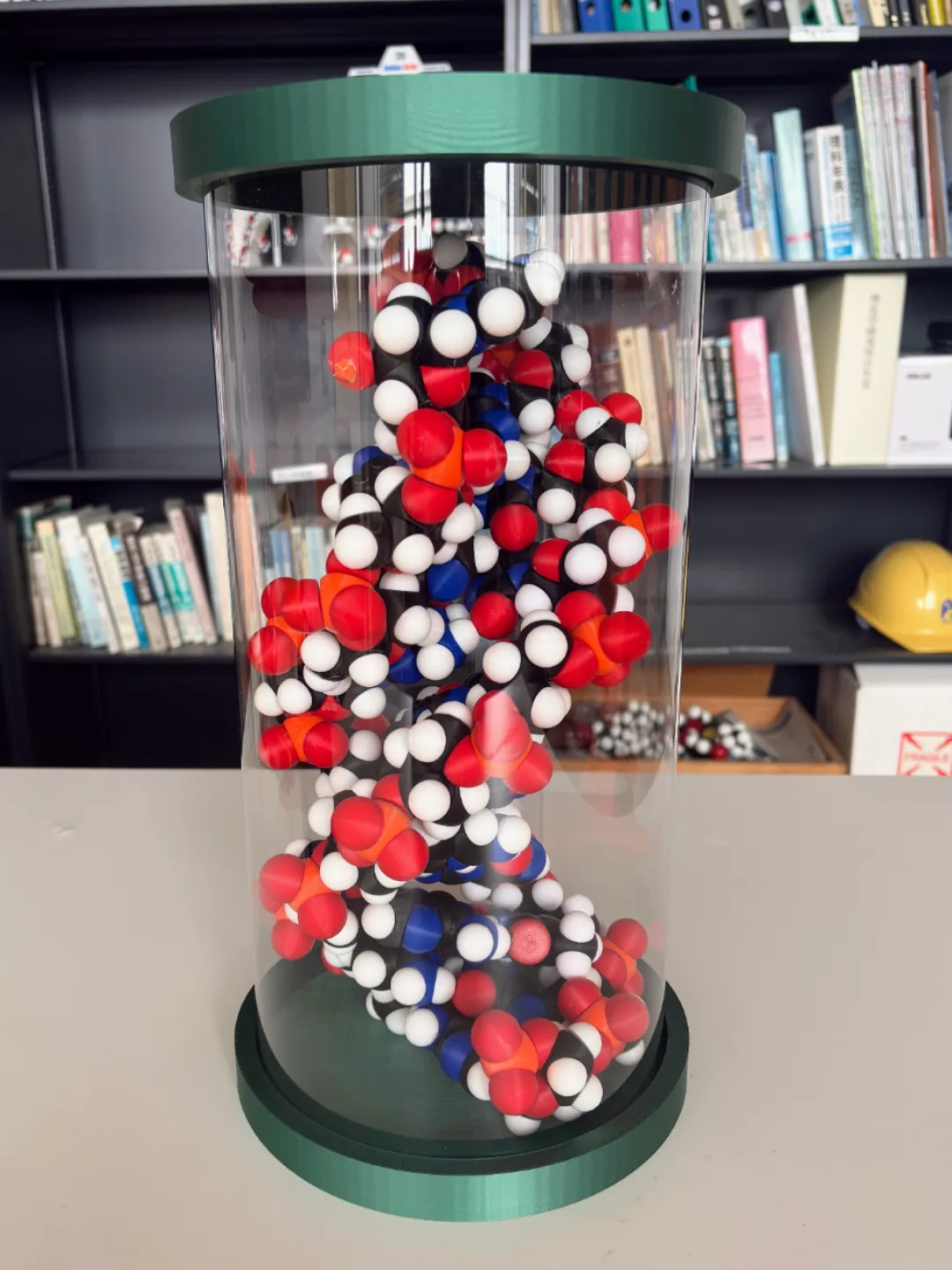
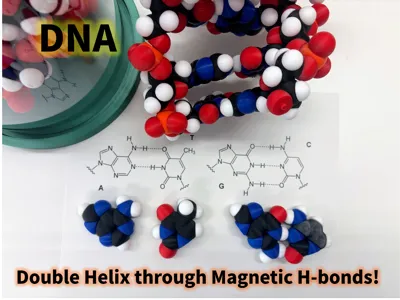
This is an all-atomic molecular model of deoxyribonucleic acid (DNA), created using molfidget. Hydrogen bonds are represented by magnets, allowing you to assemble two complementary strands into a double helix.
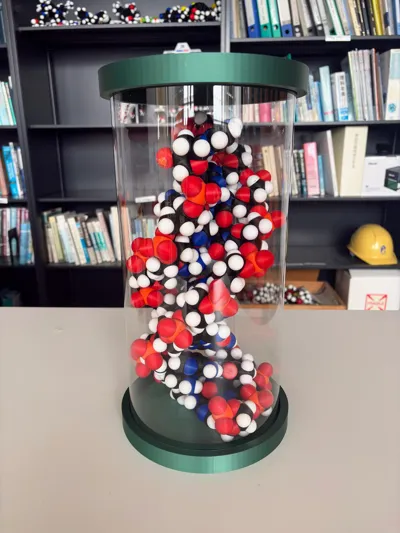
In the print profile, there are separate plates for the bases (A, T, G, and C) and for the deoxyribose–phosphate chains. The deoxyribose–phosphate chains are available in two versions: a fully flexible version (chain-flex) and a version fixed to the helical geometry (chain-fixed). I recommend using the fixed version for at least one of the two strands. If both strands are flexible, the structure tends to form a ladder-like shape (as shown in one of the model images) and does not spontaneously form a helix. I have not tested using fixed chains for both strands, but this configuration should also work and may be easier for display purposes.
You will need disc-shaped neodymium magnets with a diameter of 5 mm and a thickness of 3 mm. An A–T base pair requires four magnets, while a G–C base pair requires six magnets. Super glue (gel type recommended) is required to fix the axis. After assembling the molecules, glue the magnets into the holes. Make sure that the magnetic polarity is consistent among all base pairs (for example, assign the N pole to hydrogen and the S pole to oxygen and nitrogen).
For each base pair, you need to print one pair of bases (either A–T or G–C) and two deoxyribose–phosphate chains. The model is modular, so you can build any DNA sequence you like. Be sure that the two strands are complementary. For example, if one strand is 3′-ATGGCC-5′, the complementary strand must be 3′-TACCGG-5′; otherwise, a double helix will not form.
One full turn of the DNA helix requires approximately 10 base pairs, so a large number of parts is needed. For H2D users, I have prepared plates containing four copies of each component. You can also duplicate components and print them individually if you prefer. However, I do not recommend mixing different types of components, as assembly becomes difficult due to the similar appearance of the parts.
Assembly instructions are included in the model images. They also contain several useful tips, especially for assembling the chain-fixed deoxyribose–phosphate parts.
Printing and assembling this model is quite time-consuming, but I find it very educational. I highly recommend assembling it together with students as a hands-on way to learn about DNA.
For displaying the assembled DNA double helix, I designed a transparent column using printed lids and a transparent PET sheet (0.5 mm thick). The lid model is also included. This makes a nice display for science classrooms and laboratories.





💬MakerWorld Community Comments(7)
★MakerWorld Original Reviews