
Model Overview & Print Notes
A record that actually plays: the rickroll
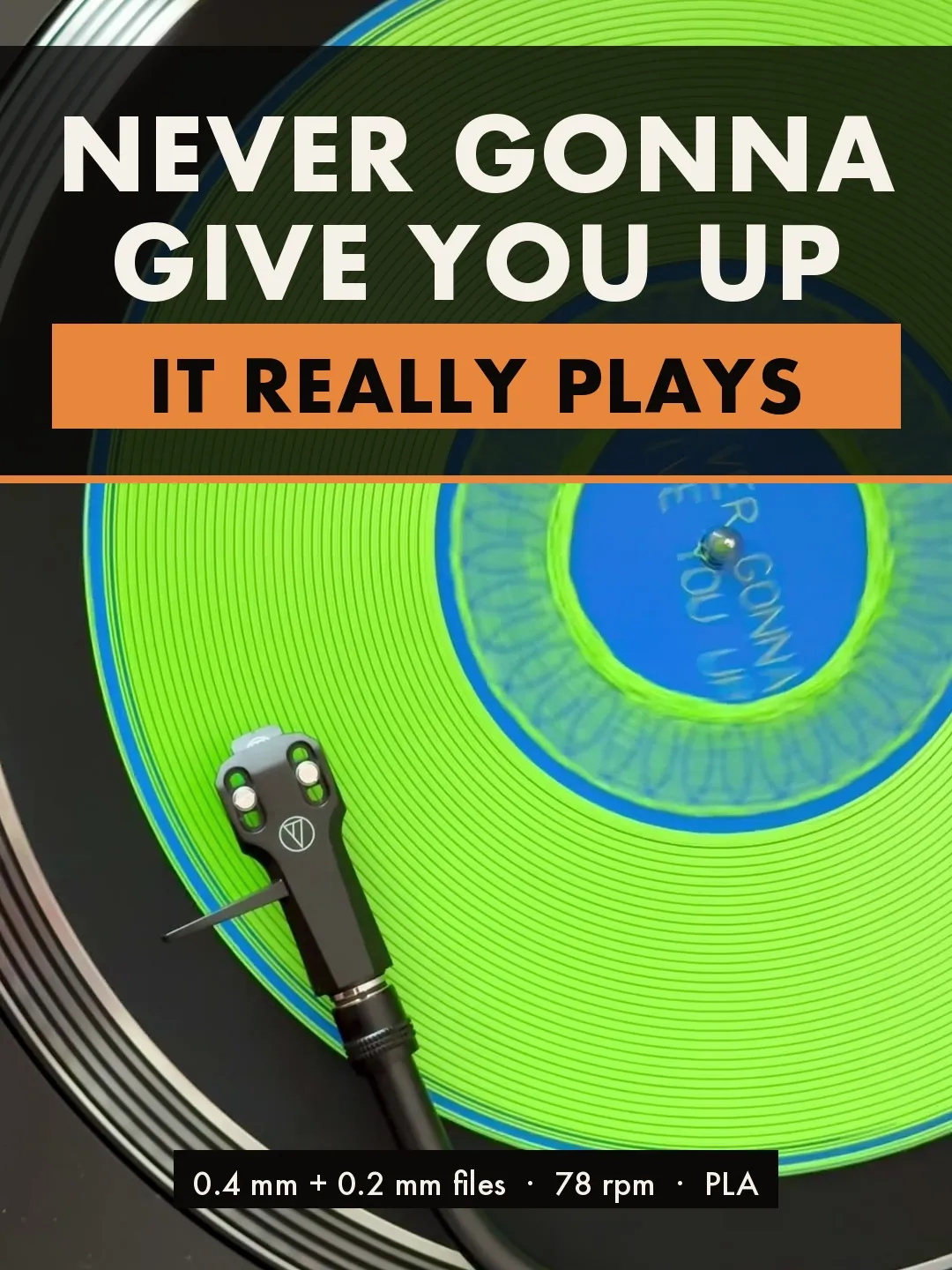
This is a record. You print it, put it on a turntable at 78 rpm, and it plays exactly what you think it plays.
Printed records are usually a gimmick, and the reason is fair: a printer resolves 0.2 mm in Z, a record groove is 28 µm deep, so modulating the groove up and down leaves about two bits of amplitude. The groove in this model moves sideways instead, in XY, where the motion is continuous and there are no layers at all. The limit becomes how tightly an extruded bead can turn, which was measured on a printed disc rather than guessed.
Be clear about what you are getting: it is lo-fi. The usable band ends between roughly 550 and 1000 Hz depending on the file and where the needle is, so you get the melody and there is audible surface noise underneath. You will recognise it from across the room, and that is the point.
Hear it first: youtube.com/shorts/Oa8asXuxjOY
Files
| File | Nozzle | Layer | Audio on the disc | Diameter |
|---|---|---|---|---|
| nggyu-0.4mm.3mf | 0.4 mm | 0.20 mm | 16 s | 250 mm |
| nggyu-0.2mm.3mf | 0.2 mm | 0.10 mm | 30 s | 250 mm |
The 0.2 mm file holds almost twice as much music, because a finer nozzle needs less room between grooves. Both are plain solids: you slice them with your own profile, so nothing here bypasses your printer settings.
Print settings
- PLA. Not PETG, not TPU: the groove has to stay hard and dimensionally stable.
- 100% infill, or at least enough solid layers that the groove floor is solid.
- No supports, no raft. Brim optional.
- Do not scale the model. Diameter, groove pitch and playback speed are one calculation; scaling breaks the timing and the groove shape.
- It needs a 256 mm bed. On a smaller printer, generate a smaller disc with the tool below.
- Watch the first layer. A patchy base means a bad groove, and you are hours from finding out.
Playing it
- 78 rpm. At any other speed it plays at the wrong pitch.
- Tracking force about 2 g, anti-skate 2.
- Lower the needle with the cueing lever onto the wide run-in groove at the edge.
- Use a cheap cartridge with a replaceable stylus. PLA is softer than vinyl and wears a needle faster. Treat the needle as a consumable and keep your good one for records.
- If the stylus skates across the surface instead of tracking, lift it straight away.
⚠ Beta. You print and play this at your own risk.
This is experimental. Not every printer has been tested, a disc takes hours to print, and a printed record can wear or damage a stylus. If you are not willing to risk a needle, do not print this.
Make your own record
The generator is open source (MIT) and runs entirely on your own machine, with no account and no server: github.com/TanskiSzymon/vinyl-engine
Drop in any audio file, pick the speed and the diameter, and it writes either ready to print G-code or a 3MF like this one. The repository also has the engineering write-up, printer templates, and a calibration loop that plays a tuning disc, listens to your own turntable and corrects later discs for what it measured. Contributions are welcome.
Yes, it really is that song, cut into the groove rather than sampled from anywhere.

💬MakerWorld Community Comments(96)
★MakerWorld Original Reviews